
B
Fire behavior
Combustible material with a very limited contribution to fire. Class B is the second-best Euroclass, immediately below Class A (non-combustible), and guarantees that the material barely propagates the flame..
Our profiles and wall protectors are classified with Euroclass B-s1,d0 according to the UNE-EN 13501-1 standard, the most demanding European standard for construction materials in buildings for public use.
| Fire behaviour Fire behaviour |
Smoke production Smoke production |
Flaming droplets Flaming droplets |
|---|---|---|
| B | s 1 | d 0 |
The B-s1,d0 classification groups three independent parameters that together define the complete behavior of the material in fire.
Combustible material with a very limited contribution to fire. Class B is the second-best Euroclass, immediately below Class A (non-combustible), and guarantees that the material barely propagates the flame..
Low smoke production and minimal opacity. The s1 classification is the most favorable: the smoke generated during combustion is scarce and not very dense, which improves visibility and facilitates evacuation of the building.
No falling flaming droplets or particles during combustion. Class d0 is the best possible in this parameter, eliminating the risk of the material contributing to the spread of fire to other areas..
The CTE (Technical Building Code) requires materials with a high fire reaction classification in hospitalization areas, operating rooms and evacuation routes.
With low smoke production (s1) and no flaming droplets (d0), escape routes remain clearer and safer for longer.
Many technical specifications for public buildings, senior residences, and hotels expressly require class B-s1,d0 or higher.
El certificado emitido por AFITI-LICOF es un documento oficial que acredita el cumplimiento normativo y protege a prescriptores, instaladores y propietarios.
The Euroclass classification requires a rigorous technical process carried out by laboratories accredited and recognized by the relevant authorities.
The manufacturer prepares representative samples of the final product, including all color and substrate variants, as specified in the field of application.
The accredited laboratory performs the tests according to the UNE-EN 13501-1 standard, which includes the SBI (Single Burning Item) test and other complementary tests.
Laboratory technicians analyze the data obtained in the tests: heat release rate, smoke production, opacity, and presence of flaming droplets.
The laboratory issues the Fire Reaction Classification Report, an official document that certifies the Euroclass obtained and its field of application.
At Ziko Europa S.A., we obtained our fire reaction classification from the AFITI-LICOF laboratory, the official fire testing laboratory of the Spanish Ministry of Industry, founded in 1975.
The report certifies the B-s1,d0 classification for our entire range of PVC wall protectors in accordance with the UNE-EN 13501-1:2019 standard, including colour and substrate variants as detailed in the scope of application of test EXAP No. 4011T20.
The classification is valid for all available colors and for plasterboard substrates with a density equal to or greater than 523.5 kg/m³ with Euroclass A1 or A2-s1,d0, as indicated in the technical report.
The European harmonised reaction to fire classification system establishes seven classes (A1, A2, B, C, D, E, F) and additional criteria for smoke and flaming droplets.
The standard defines a scale of seven main classes:
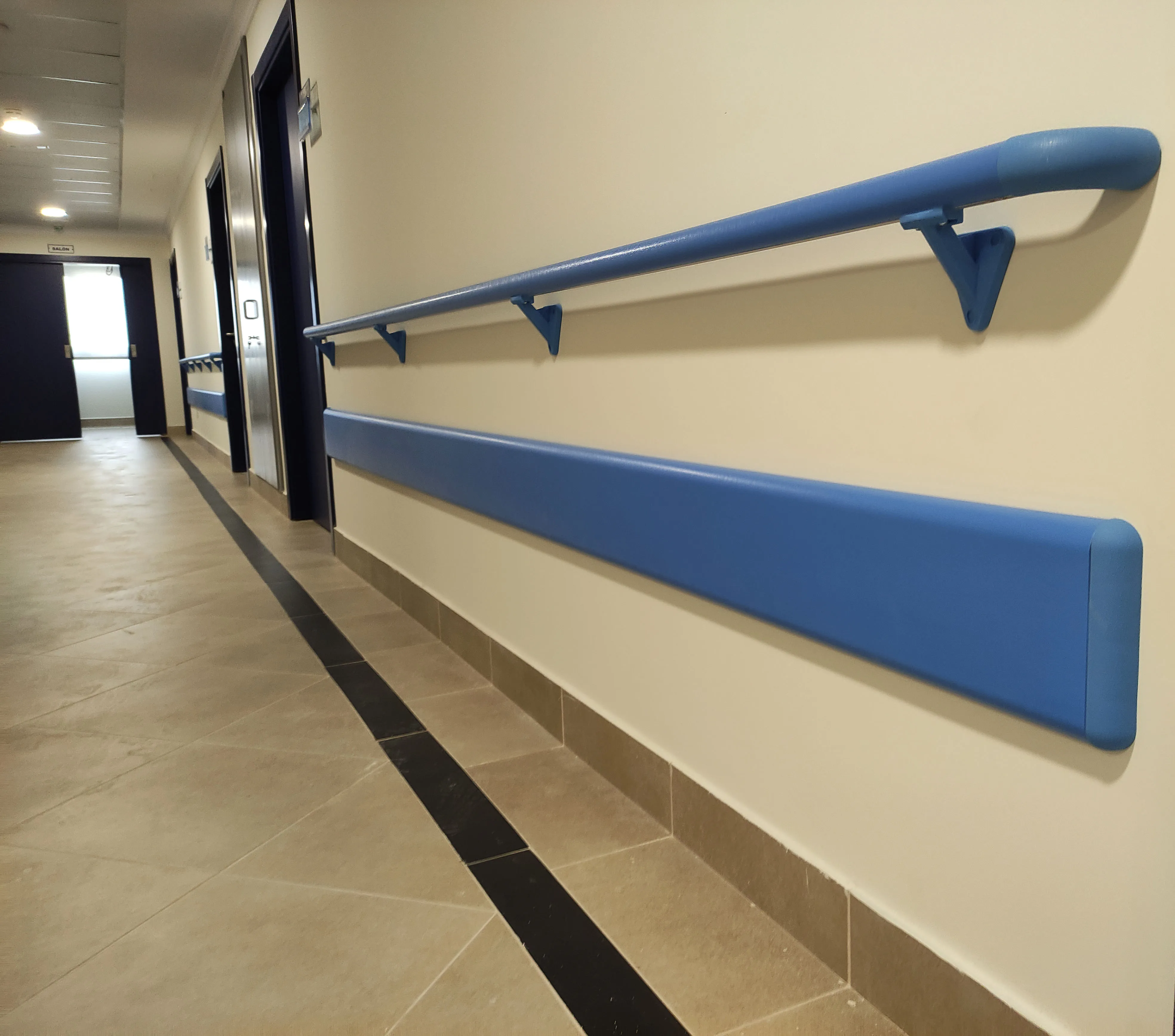
Our products are designed for environments where fire safety is non-negotiable..
Hospitalization areas, operating rooms, emergency rooms and corridors where regulations require maximum fire protection.
Centers where residents may have reduced mobility, making fire prevention and evacuation critical.
Schools, universities, and teaching facilities where large groups of people gather.
Hotel establishments subject to strict fire protection regulations in all common areas and rooms.
Administrative offices, courts, museums, and any publicly owned or used building with high capacity.
Metros, airports, stations and high traffic areas where fire regulations are especially rigorous.