
Frequently Asked Questions
Below are the most common questions our customers usually ask us:
For a facility already in operation, it is straightforward: look at the walls and measure the height at which the walls and corners are damaged, before repairing them.
For a facility not yet open, we can measure the height of the wheelchair footrests and their handles, as these will be the points of contact. When moving beds, we should measure the height of the protruding corners.
This is strictly regulated at national level. The main regulation is the Technical Building Code (CTE), specifically in the Basic Document on Safety in Use and Accessibility (DB-SUA).
In addition to this national standard, each Autonomous Community has its own accessibility regulations and local ordinances, which may be even stricter (but never less than the CTE).
Requirements are divided according to type of use and height. The general height regulated by the CTE in DB-SUA 1 (section 4.2.4 for stairs and 4.3.4 for ramps):
The standard handrail height must be placed between 90 and 110 cm.
The CTE requires a second lower handrail in specific cases:
Educational centres: In nursery schools and primary schools a second handrail is mandatory at a height of between 65 and 75 cm.
In hospitals, care homes or public buildings with ramps and stairs on accessible routes,
this double handrail is strictly required (the upper one at ~100 cm and the lower one at ~70 cm) to support children and wheelchair users.
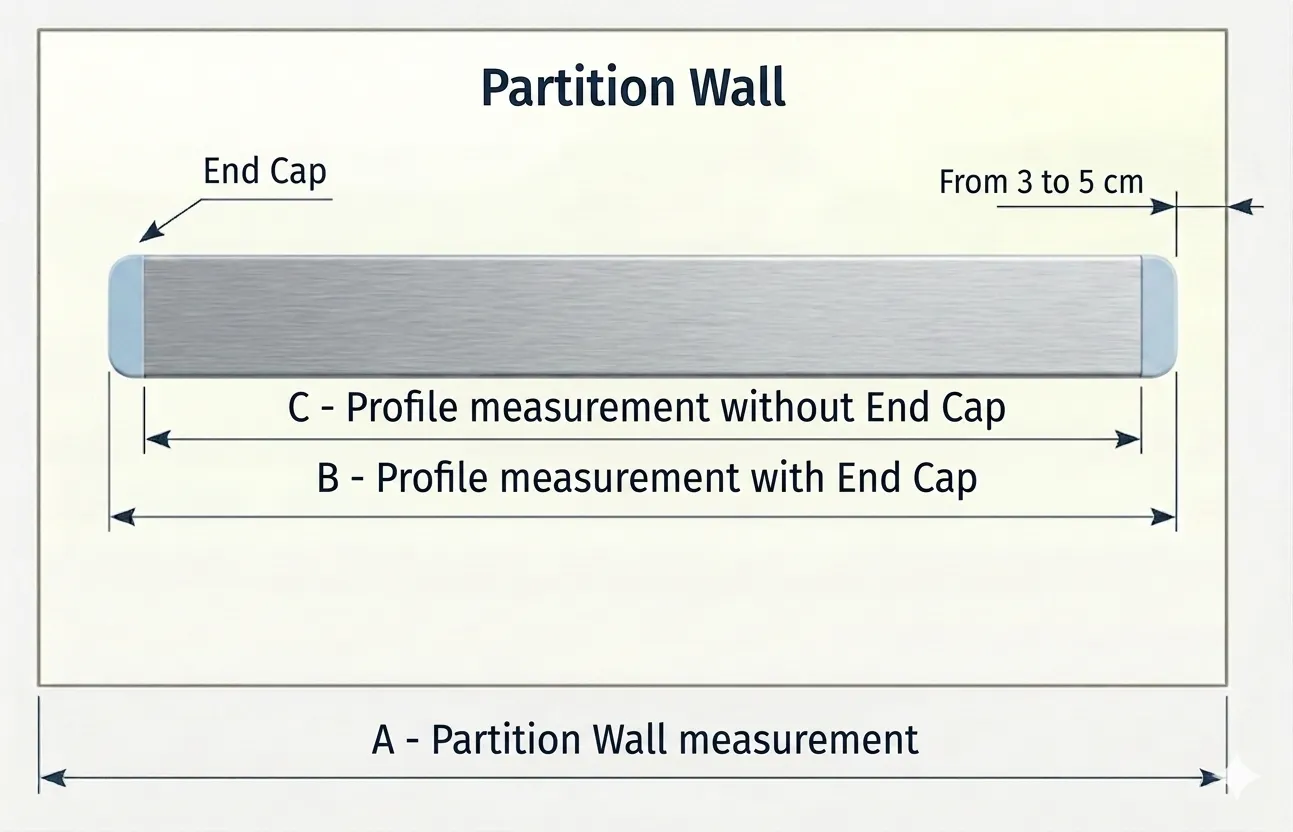
To obtain the correct measurement for the horizontal profile, we must measure the total length of the wall to be fitted and from this measurement we recommend subtracting 3 to 5 cm at each end,
that is, 6 to 10 centimetres per wall. You should also subtract, where applicable, the corner guard measurement, which can be 3, 5 or 7.5 centimetres depending on the chosen model.
A diagram is shown below:
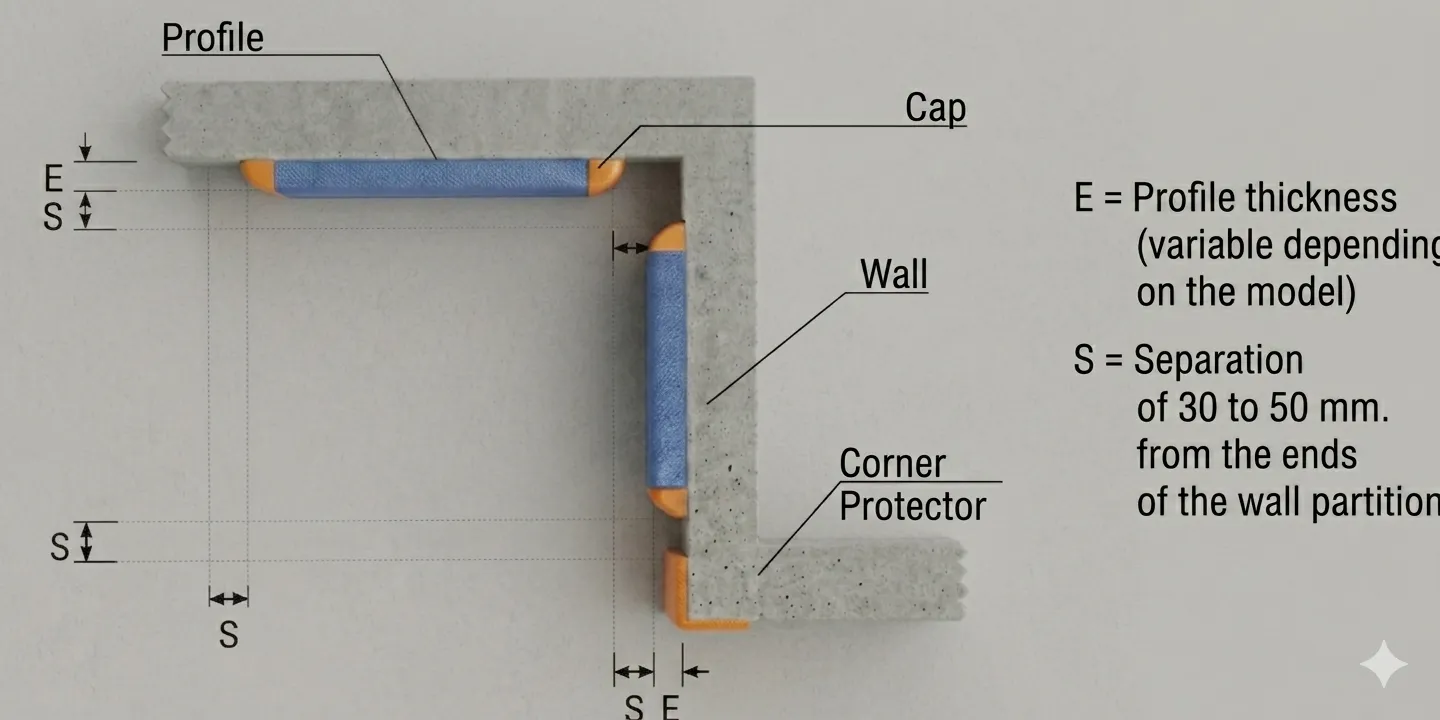
At corners we must leave 3 to 5 centimetres, as failing to do so will cause one profile to clash with another.
Furthermore, neither beds nor wheelchairs will hit the wall, as the gap is too small.
To take measurements for the ZK801 cladding sheet or the ZK805 flat profile, we must measure from end to end of the wall,
and express the measurement in millimetres so that it fits as precisely as possible,
but never round upwards, as doing so could result in the piece being larger than the space in which it is to be installed.
Yes, we can carry out measurements.
Fitting our profiles is very straightforward. Place the aluminium profile on the wall, mark the drill points (the aluminium already comes with the holes pre-drilled for installation), drill those holes, insert the wall plug, then screw in the aluminium, and finally clip the plastic profile on top. The end caps are anchored to the aluminium.
In addition to this simple explanation, we have more detailed installation instructions for all our models, both for custom-cut and free-length versions.
Fitting our handrails is very straightforward. If you choose custom-cut, they will arrive fully assembled, even with the brackets already installed,
you simply need to place the handrail against the wall, mark the bracket drill points, drill those holes and insert the wall plugs.
Then screw in the handrail and clip the plastic profile on top.
In addition to this simple explanation, we have more detailed installation instructions for all our models, both for custom-cut and free-length versions.
Fitting our corner guards is very straightforward. Place the aluminium profile on the wall, mark the drill points (the aluminium already comes with the holes pre-drilled for installation), drill those holes and insert the wall plug,
then screw in the aluminium and clip the plastic profile on top.
The end caps are anchored to the aluminium.
For corner guards that do NOT include aluminium, a generous layer of adhesive must be applied and the guard placed on the wall.
In addition to this simple explanation, we have more detailed installation instructions for all our models, both for custom-cut and free-length versions.
Position the cladding sheet on the wall and first verify that the piece fits correctly in the section where it is to be installed.
Then apply a generous layer of adhesive and place it on the wall.
We recommend the use of neutral silicone. It is very important that it is not acidic, as acidic silicone will cause the profile to detach within days or weeks.
We have installation instructions for all our models, both for custom-cut and free-length versions.
Free-length means the profiles are supplied at full length, ready to be cut on site to the required dimensions.
Yes, not only is it possible, it is in fact done routinely,
as we are often working in areas where it is impossible to suspend activity for 24 or 48 hours, such as emergency departments.
Custom cuts are available for foreign clients with an additional charge.
Our plastic profiles and cladding sheets are through-coloured and textured, which is very important, as it means that when scratches occur they are concealed within the texture.
If the colour were surface-only, scratches would reveal a different colour, making the wear on the piece far more noticeable.
The B-s1,d0 classification is a Euroclass fire reaction rating for construction materials, in accordance with standard UNE-EN 13501-1, which guarantees very limited contribution to fire, low smoke opacity, and no flaming droplets. It is a high-safety standard for cladding products.
What does the classification mean?
B: Combustible material with low contribution to fire.
s1: Low smoke production and opacity, reducing the risk of asphyxiation and improving evacuation.
d0: No falling flaming droplets or particles during combustion.
All our profiles and cladding sheets hold the fire certificate required by the CTE, the Bs1d0. We hold certification from the AFITI laboratory, the official fire testing laboratory of the Ministry of Industry, established in 1975.
Our PVC is made from virgin raw material and is therefore free from Phthalates.
It complies with the provisions of Directive 2011/65/EU (RoHS Directive) on the restriction of the use of certain hazardous substances in electrical and electronic equipment, Annex II, as amended by Delegated Directive (EU) 2015/863.
NO, because there is no harmonised European Standard (hEN) that specifically governs it.
For public buildings, hospitals or schools in Spain, even though the specific product does not have a mandatory CE marking standard, compliance with the European Union laws is required and will be recorded in the Building Log Book.
Furthermore, as manufacturers in Europe we must comply with all applicable regulations, both in the selection of our raw materials, in production processes and in the final disposal of these, whether by recycling or management.
Aluminium alloy AW 6063: Aluminium-Magnesium-Silicon, equivalent in Spain to UNE L-3441 and in Germany to DIN AlMgSi0.5. This alloy provides exceptional strength.
| Mechanical properties of aluminium (EN 755-2) | ||||||
|---|---|---|---|---|---|---|
| Condition | Wall thickness (MM) | Ultimate tensile strength Rm (N/mm2) | Yield strength Rp0.2 (N/mm2) | Elongation A min (%) | Elongation A50mm min (%) | Brinell hardness (HB) |
| T5 | e≤3 | 175 | 130 | 8 | 6 | 65 |
| T5 | 3<e≤25 | 160 | 110 | 7 | 5 | 65 |
PVC from virgin raw material; our material is free from Phthalates.
Cumple con lo especificado en la Directiva 2011 /65 /UE (Directiva RoHS), sobre restricciones a la utilización de determinadas sustancias peligrosas en aparatos eléctricos y electrónicos, anexo II, modificado por la directiva delegada (UE) 2015/863.
It is classified under Regulation (EC) No 1272/2008 as a non-hazardous preparation.
| Mechanical properties of PVC | ||||||
|---|---|---|---|---|---|---|
| Properties | Value | Units | Standard | |||
| Vicat temperature (5 kg) | 78° | °C | UNE EN ISO 306:1994 | |||
| Density | 1,48 - 1,52 | G/cm3 | EPT 92-13 UNE EN ISO R 1 183 | |||
| Tensile strength | 350 | Kg/cm2 | EPT 92-25 / UNE EN ISO 527 | |||
| Elongation at break | 100 | % | EPT 92-25 | |||
Custom cuts are available for foreign clients with an additional charge.
Today, virtually all walls on which our protections are installed are plasterboard.
For handrails, NO reinforcement is required in plasterboard walls; we simply need double-layer PLASTERBOARD to ensure they are securely anchored.
NO reinforcement is required in plasterboard walls; we simply need double-layer PLASTERBOARD to ensure they are securely anchored.
We do not perform installations abroad, as having our own staff install our products significantly increases installation costs.
However, we do provide very detailed and free assembly instructions to all our customers.
Furthermore, our products do not require skilled personnel.
All packages will be numbered, and we will keep a record of the contents of each package so that, in case of loss, a replacement can be dispatched as quickly as possible.
If requested with the order, this package detail can be included with the delivery, although we do not normally do this in order to avoid delaying dispatch.
All pieces under 4 metres will be supplied in a single length, free from joints, for a better aesthetic finish, unless the customer requests a different minimum length due to handling or transport constraints.
Orders of less than 200 linear metres will be cut to 3m or another shorter length.
The prices quoted include cardboard box packaging and transport (within the Iberian Peninsula). Any special requirements must be consulted separately.
It depends on the size of the order, the orders we have in production at the time yours is placed, and the stock we have available.
Taking all of this into account, most of our orders are dispatched in less than 1 week (orders of less than 300 metres).
To ensure your order arrives on time, please consult us about delivery lead times.
Normally, around 100 metres of profile or handrail can be installed per day, with custom-cut material supplied by us and a 2-person team. Two people are important as all our profiles are long, which makes installation much easier.
Yes, we can produce any custom colour, but as the cost involved is high we require a minimum order of 1,000 linear metres.
You should also be aware that the supply lead time increases considerably, as several samples must be produced and sent for your approval before manufacturing the order.
Our profiles are made of PVC, fully recyclable. In the factory, plastic profile offcuts are separated by colour, shredded and re-extruded.
They also contain aluminium, which is also recyclable — in fact our profiles may once have been a drinks can.
No, it is not necessary. Our profiles are very easy to install and require no specialist training.
All our products carry a two-year warranty from the date of supply, covering any manufacturing defects.
This warranty will in no case cover damage due to misuse, wear, or deterioration of parts not supplied by us.
Yes, they can be installed on curved surfaces, but the installation is more complex.
We ship worldwide. We have shipped as far as Australia — the problems we solve are the same everywhere in the world.
We founded Ziko Europa SA in 1989 and since 1991 we have been supplying and installing wall protections, handrails and corner guards.
Over 35 years at your service